

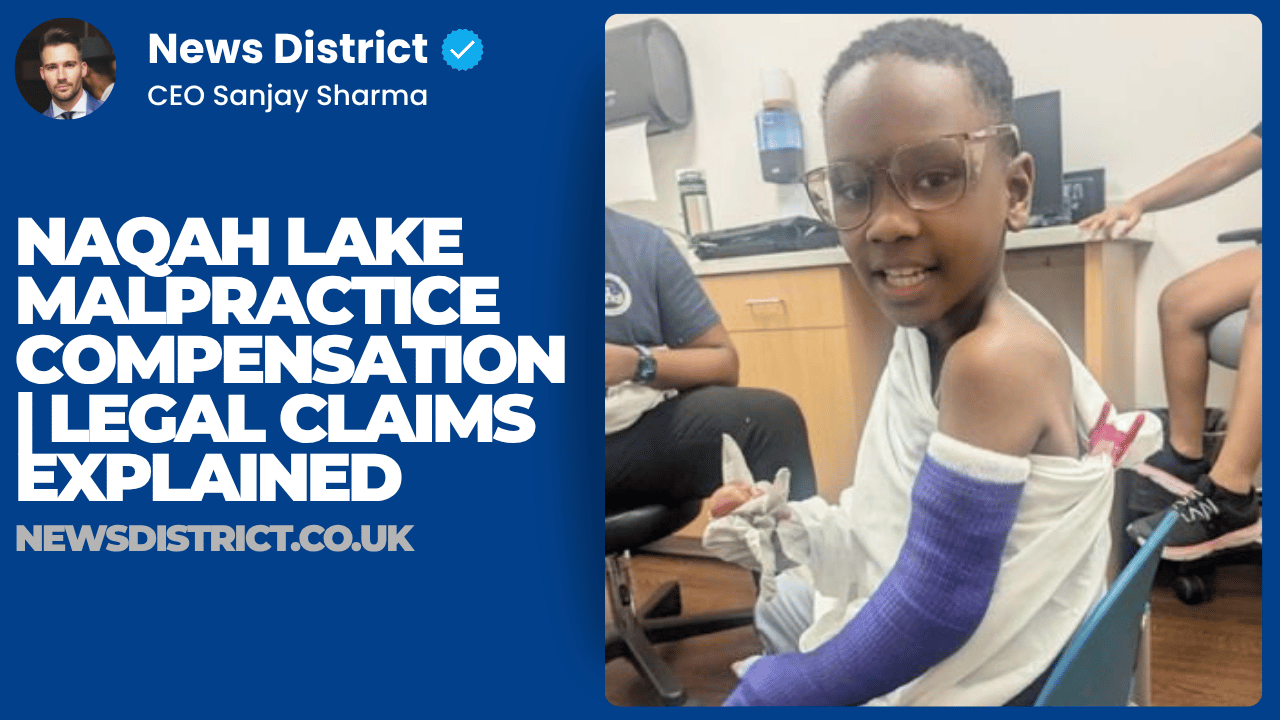
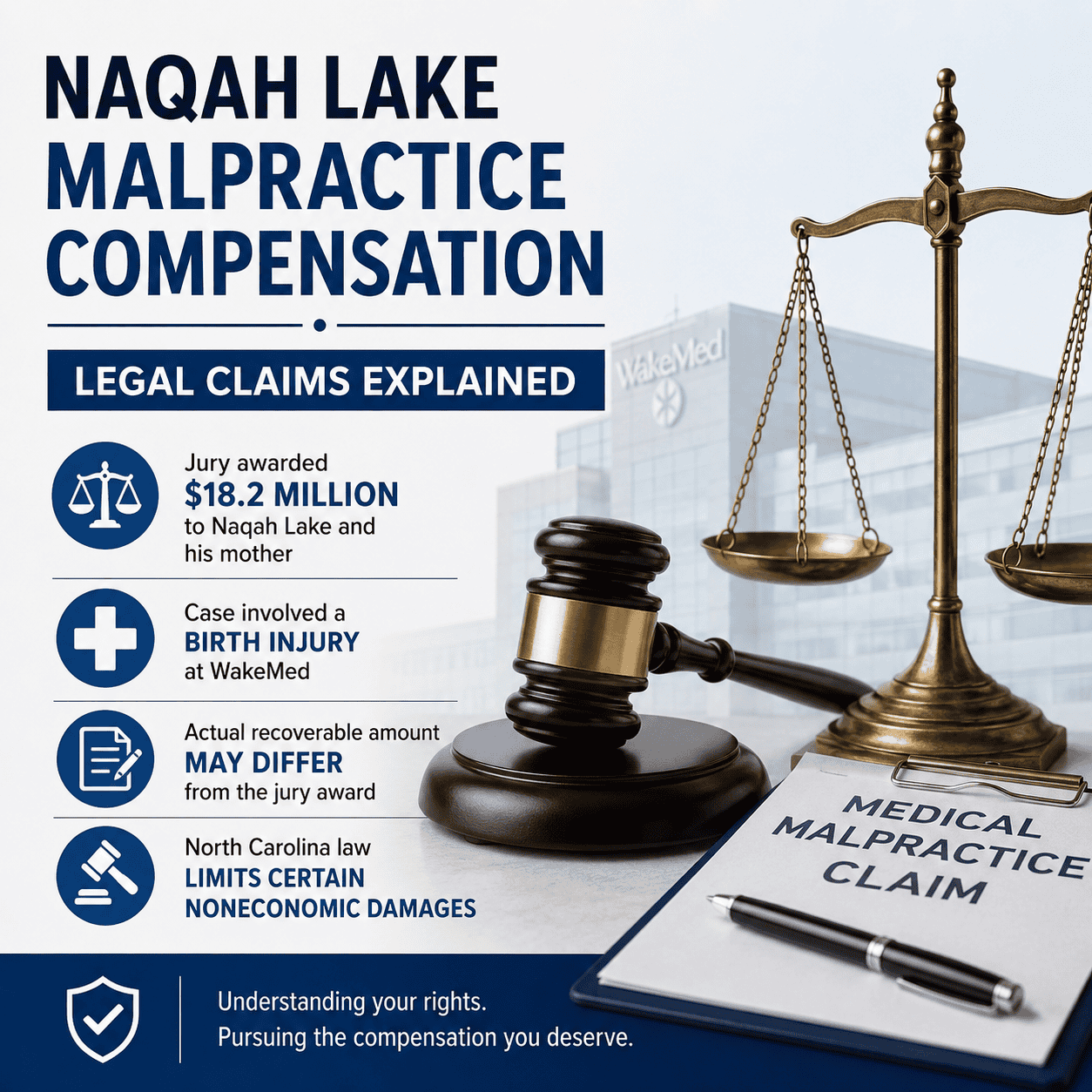
Naqah Lake and his mother were awarded $18.2 million by a Wake County jury in a medical malpractice case involving a birth injury at WakeMed. The actual amount recoverable can differ from the jury award because North Carolina law limits certain noneconomic damages.
What Happened in the Naqah Lake Malpractice Case
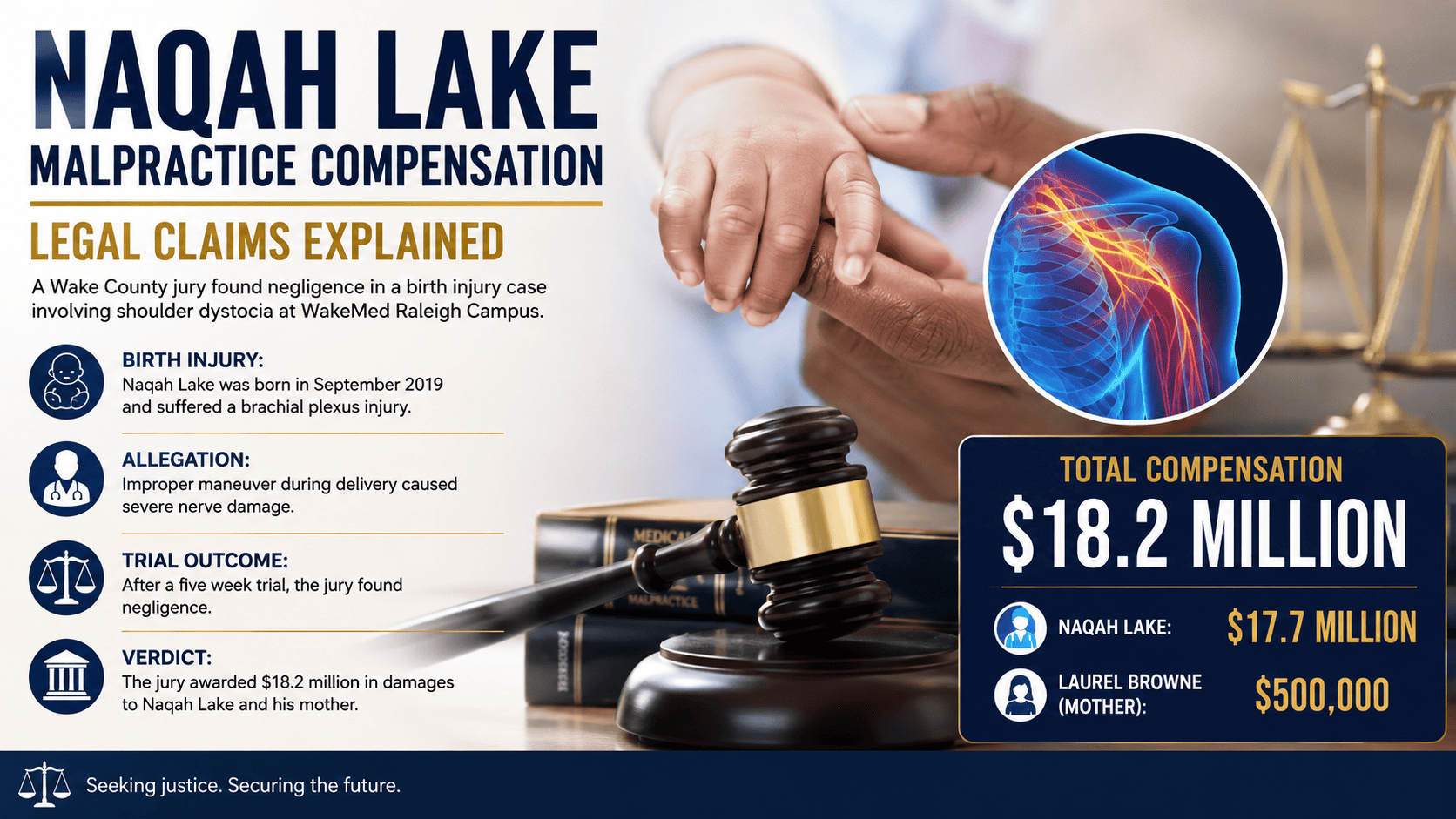
Naqah Lake was born at WakeMed Raleigh Campus in September 2019. His delivery involved shoulder dystocia, a serious birth complication in which a baby’s shoulder becomes stuck during delivery.
The lawsuit alleged that a resident physician used an improper maneuver while managing the delivery. The plaintiffs argued that the maneuver caused severe damage to the baby’s brachial plexus, a group of nerves that controls movement and feeling in the shoulder, arm, and hand.
The defense disputed the allegations and the legal responsibility for the injuries. After a five week trial, a Wake County jury found negligence and awarded damages to Naqah Lake and his mother, Laurel Browne.
The reported verdict was $18.2 million. News reports state that $17.7 million was awarded to Naqah and $500,000 to his mother.
How Much Was the Naqah Lake Compensation Award?
The jury awarded a total of $18.2 million. The award included economic and noneconomic damages.
| Compensation category | Reported amount |
|---|---|
| Total jury award | $18.2 million |
| Award to Naqah Lake | $17.7 million |
| Award to his mother | $500,000 |
| Economic damages | $2.2 million |
| Noneconomic damages | $16 million |
Economic damages generally relate to financial losses that can be supported with evidence, such as medical treatment and other measurable costs.
Noneconomic damages cover losses that do not have a simple price tag. Under North Carolina law, this category can include pain, suffering, emotional distress, loss of consortium, inconvenience, and other nonfinancial harm.
Why the $18.2 Million Verdict Does Not Automatically Mean an $18.2 Million Payment
A jury verdict and the final amount entered as a judgment are not always the same.
North Carolina has a statutory limit on noneconomic damages in medical malpractice cases. The law provides a base limit that is adjusted for inflation every three years. The North Carolina Office of State Budget and Management states that the limit is $712,847 effective January 1, 2026.
The limit applies to noneconomic damages, not to economic damages.
This distinction is important in the Naqah Lake case because the jury reportedly awarded $16 million in noneconomic damages. The court must determine how the applicable law affects the final judgment. News reports also noted that the judge would have the final say on the amount WakeMed must pay.
North Carolina Medical Malpractice Damages Cap
North Carolina General Statute § 90-21.19 generally limits noneconomic damages in a medical malpractice action. The statute also requires the limit to be adjusted periodically based on the Consumer Price Index.
For 2026, the published noneconomic damages limit is $712,847.
The cap does not apply in every case. North Carolina law provides an exception when two conditions are met.
First, the plaintiff must have suffered disfigurement, loss of use of part of the body, permanent injury, or death.
Second, the defendant’s conduct that caused the injury must have involved reckless disregard of the rights of others, gross negligence, fraud, intentional conduct, or malice.
Both requirements matter. A permanent injury by itself does not automatically remove the damages cap.
Did the Naqah Lake Jury Find Gross Negligence?
No.
Reports about the verdict state that the jury found negligence but did not find gross negligence. That distinction is legally important because the North Carolina damages cap contains an exception for certain cases involving permanent injury together with qualifying aggravated conduct, including gross negligence.
The jury’s finding therefore matters when determining how the noneconomic damages portion of the verdict may be treated.
The reported $18.2 million figure should therefore be described as the jury verdict, rather than automatically describing it as the final compensation paid to the family.
What Is Medical Malpractice Under North Carolina Law?
North Carolina law defines a medical malpractice action as a civil action seeking damages for personal injury or death arising from the furnishing or failure to furnish professional health care services by a health care provider.
The definition can also cover certain claims against hospitals involving administrative or corporate duties, when the claim arises from the same facts as a professional medical negligence claim.
A medical malpractice claim can involve a doctor, hospital, nurse, or another qualifying health care provider.
However, a poor medical result does not automatically establish malpractice.
What Must Be Proven in a Medical Malpractice Claim?
A medical malpractice case generally requires proof that the health care provider failed to meet the required standard of care and that the failure caused the claimed injury.
North Carolina law states that a health care provider is not liable unless the trier of fact finds that the provider’s care was not consistent with the applicable standards of practice under the circumstances.
A claimant therefore normally needs evidence addressing several key questions.
| Legal issue | What it means |
|---|---|
| Duty of care | The provider owed a professional duty to the patient |
| Standard of care | The required level of professional care under the circumstances |
| Breach | The provider failed to meet that standard |
| Causation | The breach caused or contributed to the injury |
| Damages | The patient suffered legally compensable harm |
These elements make medical malpractice cases different from ordinary complaints about medical treatment.
Why Expert Medical Evidence Matters
Medical malpractice cases often depend heavily on expert evidence.
North Carolina has specific requirements for experts who testify about the appropriate standard of health care. In many situations, the expert must have the required professional license and relevant practice or teaching experience connected to the specialty involved in the case.
For a birth injury claim, expert evidence may address issues such as:
- The medical condition during delivery
- The applicable standard of obstetric care
- Whether a particular procedure or maneuver was appropriate
- Whether the provider departed from accepted practice
- Whether the alleged departure caused the injury
- The extent and expected duration of the injury
- Future medical and rehabilitation needs
Expert testimony does not guarantee a successful claim. The evidence must still satisfy the legal requirements for liability and causation.
What Was the Injury in the Naqah Lake Case?
The reported case involved a severe brachial plexus injury.
The brachial plexus is a network of nerves connecting the spinal cord with the shoulder, arm, and hand. Damage to these nerves can cause weakness, loss of movement, sensory problems, or permanent impairment.
According to reporting about the case, Naqah suffered permanent nerve damage affecting his left arm and hand. The jury accepted the plaintiffs’ claim that negligence during the delivery caused the injury.
A brachial plexus injury can have different causes and levels of severity. The existence of such an injury alone does not establish medical malpractice. The legal question is whether the evidence proves that the health care provider breached the applicable standard of care and caused the injury.
What Are Economic Damages?
Economic damages compensate for losses that can be measured financially.
In a birth injury case, potential economic damages may include:
- Past medical bills
- Future medical treatment
- Physical therapy
- Occupational therapy
- Assistive equipment
- Rehabilitation expenses
- In-home care
- Other medically necessary services
- Lost income when legally recoverable
- Reduced future earning capacity when supported by evidence
North Carolina’s medical malpractice damages cap applies to noneconomic damages. It does not create the same type of statutory ceiling for economic damages.
The amount of economic compensation must still be supported by evidence.
What Are Noneconomic Damages?
Noneconomic damages compensate for losses that are difficult to calculate using bills or receipts.
They may include:
- Pain and suffering
- Emotional distress
- Physical impairment
- Disfigurement
- Loss of use of a body part
- Inconvenience
- Loss of consortium
- Other nonfinancial harm
North Carolina law specifically defines noneconomic damages in this context and separates them from economic damages.
The Naqah Lake jury reportedly awarded $16 million in noneconomic damages. That amount reflected the jury’s assessment of the nonfinancial effects of the injury.
Why the Damages Cap Is Important in This Case
The damages cap is one of the most important legal issues connected with the Naqah Lake verdict.
The jury reportedly valued the noneconomic portion of the claim at $16 million. However, North Carolina’s statutory limit for noneconomic medical malpractice damages is $712,847 for causes of action subject to the 2026 limit.
The law states that when a verdict exceeds the applicable limit, the court modifies the judgment as required by the statute.
This means readers should not treat the headline jury award as proof of the final payment without checking the judgment and any later court rulings.
Microsoft Lost a Lawsuit to a Gamer Over Account Access After Major Legal Battle
A Brazilian court ruled against Microsoft after a gamer lost access to his Microsoft account and digital Xbox games following an account security issue.

What Does Permanent Injury Mean for the Cap?
Permanent injury is one part of the statutory exception to the noneconomic damages cap.
However, permanent injury alone is not enough.
The law requires both a qualifying injury and qualifying conduct by the defendant. The second requirement includes reckless disregard, gross negligence, fraud, intentional conduct, or malice.
This distinction is especially relevant to the Naqah Lake case because reports state that the jury found negligence but did not find gross negligence.
Can Economic Damages Still Be Recovered Above the Noneconomic Cap?
Yes, the noneconomic damages limit does not operate as a general cap on every category of compensation.
Economic damages are treated separately. Medical costs and other measurable financial losses are not subject to the same noneconomic damages limit.
The actual amount depends on the evidence presented and the final judgment.
For a child with a permanent birth injury, future care can be an important part of the economic damages analysis. Medical experts, rehabilitation specialists, life care planners, and economists may be used to estimate future needs and financial losses.
Who Can Be Responsible for Medical Malpractice?
North Carolina’s medical malpractice statute covers a broad group of health care providers.
The statutory definition includes licensed professionals such as physicians, nurses, dentists, pharmacists, midwives, anesthesiology professionals, and others. It also includes hospitals and certain other health care facilities.
Depending on the facts, a lawsuit may therefore involve both an individual health care professional and a hospital.
The specific legal relationship between a hospital and a medical provider can affect liability. A court must determine responsibility based on the evidence and applicable law.
How Birth Injury Compensation Claims Are Evaluated
A birth injury malpractice claim usually requires a detailed review of medical records and expert evidence.
Important records can include:
- Prenatal medical records
- Ultrasound and testing records
- Maternal health records
- Labor and delivery records
- Fetal monitoring records
- Nursing notes
- Physician notes
- Medication records
- Newborn examination records
- Specialist evaluations
- Surgery records
- Physical therapy records
- Occupational therapy records
- Long term care assessments
The purpose of reviewing these records is to establish what happened, what medical decisions were made, what the applicable standard of care required, and whether a breach caused the injury.
How Causation Is Determined
Causation is often one of the most disputed parts of a medical malpractice case.
A claimant must generally connect the alleged medical error to the injury. It is not enough to show that an injury occurred after treatment.
In a birth injury case, experts may examine the timing of the injury, delivery records, medical findings, the nature of the nerve damage, and other possible causes.
The Naqah Lake case reportedly involved a dispute over whether the injury was caused by the alleged delivery maneuver or occurred before the delivery. The jury ultimately accepted the plaintiffs’ causation position.
What Compensation Can a Birth Injury Claim Include?
The potential categories of compensation depend on the facts of each case.
| Potential damages | Examples |
|---|---|
| Medical expenses | Hospital care, surgery, medication |
| Rehabilitation | Physical and occupational therapy |
| Future care | Long term treatment and assistance |
| Assistive services | Equipment and support services |
| Lost earning capacity | Reduced ability to earn income |
| Pain and suffering | Physical and emotional effects |
| Disfigurement | Permanent changes to appearance |
| Loss of function | Permanent impairment of body function |
| Other financial losses | Documented costs caused by the injury |
Not every claim will include every category.
The evidence must establish that the losses resulted from the alleged malpractice and are legally recoverable.
Is Naqah Lake’s $18.2 Million Award a Settlement?
The reported $18.2 million amount is a jury verdict, not the same thing as a negotiated settlement.
A settlement occurs when the parties agree to resolve a legal dispute, usually in exchange for payment or other terms. A jury verdict is a decision reached after trial.
Current reporting describes the Naqah Lake matter as a jury verdict following a five week trial.
Some online pages have described the matter as a compensation agreement or settlement. Those descriptions should be treated carefully unless supported by court records or reliable reporting.
What Happens After a Medical Malpractice Verdict?
A verdict does not always end a case immediately.
After a jury reaches a verdict, the parties may address issues involving:
- Entry of judgment
- Statutory damages limits
- Post trial motions
- Legal fees and costs
- Settlement discussions
- Appeals
- Enforcement of the judgment
- Allocation of responsibility among defendants
In the Naqah Lake case, the reported damages cap issue is particularly important because North Carolina law requires courts to modify a noneconomic damages award when it exceeds the applicable statutory limit, unless an exception applies.
Why the Naqah Lake Case Matters for Birth Injury Claims
The case highlights several important issues in medical malpractice law.
First, a serious birth injury does not automatically establish malpractice. Evidence must connect the injury to a breach of the applicable medical standard.
Second, expert evidence can play a major role in determining whether medical care met the required standard.
Third, a jury’s valuation of damages may not always equal the final amount entered in the judgment.
Finally, North Carolina’s noneconomic damages law can have a major effect on large medical malpractice verdicts. The current statutory limit is $712,847 for 2026, subject to the law’s requirements and exceptions.
Frequently Asked Questions About Naqah Lake Malpractice Compensation
How much did the jury award Naqah Lake?
The Wake County jury awarded a total of $18.2 million to Naqah Lake and his mother. Reports state that $17.7 million went to Naqah and $500,000 went to his mother.
Was the Naqah Lake case a medical malpractice case?
Yes. The case involved allegations of medical negligence during Naqah Lake’s birth at WakeMed Raleigh Campus. A jury found negligence and awarded damages.
What type of injury did Naqah Lake suffer?
The case involved a severe brachial plexus nerve injury that was reported to have caused permanent impairment of his left arm and hand.
What is the North Carolina medical malpractice damages cap in 2026?
The published 2026 limit for noneconomic damages in North Carolina medical malpractice cases is $712,847.
Does the $712,847 cap apply to medical bills?
No. The statutory limit concerns noneconomic damages. Economic losses are treated separately.
Does permanent injury automatically remove the damages cap?
No. North Carolina law requires both a qualifying injury and qualifying conduct, such as gross negligence, recklessness, fraud, intentional conduct, or malice, for the statutory exception to apply.
Did the Naqah Lake jury find gross negligence?
Reports indicate that the jury found negligence but did not find gross negligence.
Is the $18.2 million the final amount paid?
Not necessarily. The jury’s verdict and the final judgment can differ because statutory limits and other post trial legal issues may affect the amount recoverable.
What evidence is important in a birth injury malpractice claim?
Medical records, expert testimony, delivery records, injury evaluations, treatment records, and evidence of past and future losses can all be important. The specific evidence depends on the facts of the claim.
Can a birth injury claim include future medical costs?
Potentially, yes. Future medical and rehabilitation expenses can form part of economic damages when they are supported by appropriate evidence and are legally attributable to the claimed malpractice.
Is every birth injury caused by medical malpractice?
No. Birth injuries can occur for many reasons, including complications that may happen even when appropriate medical care is provided. A malpractice claim requires proof that the applicable standard of care was breached and that the breach caused the injury.
Can the Naqah Lake case be used to predict another malpractice award?
No. Every medical malpractice case depends on its own facts, medical evidence, legal issues, injuries, and damages. A large verdict in one case does not establish a standard payout for other birth injury claims.
WIAA Arrowhead High School Waiver Lawsuit | Full Story, Legal Timeline, and Latest News
The lawsuit began after WIAA ruled Arrowhead senior Tristen Seidl ineligible for varsity football after his family moved because of a house fire.

Legal Sources for North Carolina Medical Malpractice Claims
North Carolina General Statute § 90-21.11 defines medical malpractice actions and health care providers.
North Carolina General Statute § 90-21.12 explains the standard of health care used in medical malpractice claims.
North Carolina General Statute § 90-21.19 addresses the limit on noneconomic damages and the exceptions to that limit.
The North Carolina Office of State Budget and Management lists the 2026 noneconomic damages limit as $712,847.
The reported Naqah Lake verdict was covered by North Carolina news organizations and legal industry sources following the July 2026 trial.
