

The Department for Work and Pensions has increased capacity for Personal Independence Payment reviews, meaning more claimants are now going through reassessments. The change mainly affects people whose PIP awards are due for review, while longer award periods are also being introduced for some claimants.
DWP Disability Benefit Reassessments Restarting
The Department for Work and Pensions, known as the DWP, is increasing the number of Personal Independence Payment, or PIP, award reviews that can be processed.
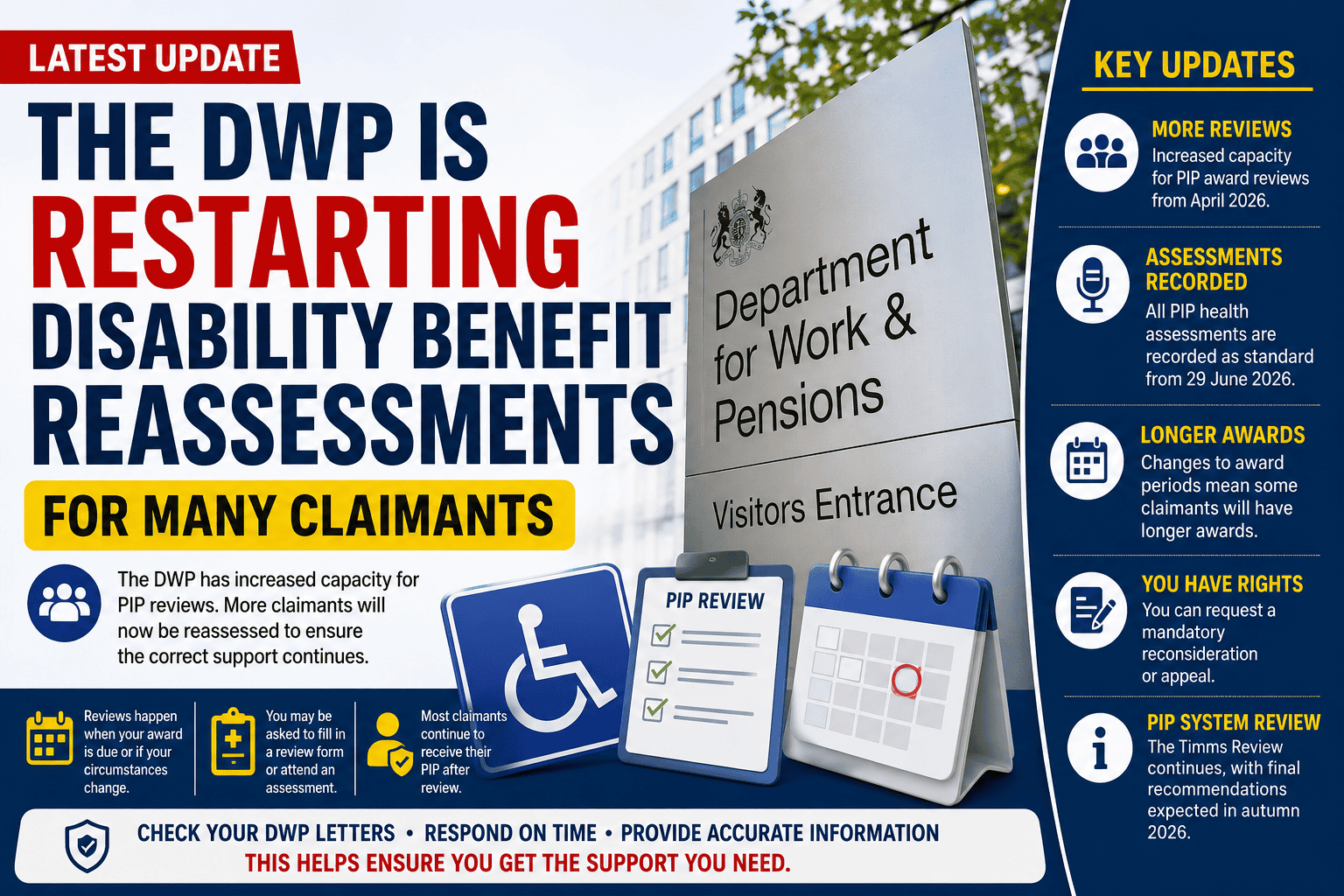
The change follows plans announced by the government to increase assessment provider capacity from April 2026. The purpose is to allow more ongoing PIP awards to be reviewed and to make sure claimants continue to receive the correct level of support.
This does not mean every person receiving disability benefits will suddenly be reassessed.
PIP reviews normally happen when an existing award reaches the end of its review period. A review can also happen if a claimant reports a change in circumstances.
The latest official figures show that PIP review activity is already significant. In the quarter ending April 2026, 130,000 planned award reviews were registered and 120,000 were cleared.
Why Is the DWP Increasing Reassessment Capacity?
The DWP has been dealing with a large workload involving new PIP claims, changes of circumstances, DLA reassessments and planned award reviews.
The government announced additional capacity for PIP award reviews from April 2026. The policy is designed to increase the number of ongoing claims that can be assessed.
A PIP review is intended to check whether a person’s needs have changed and whether their current award remains correct.
The review does not automatically mean that a claimant will lose their benefit.
A review can result in the award being:
- Increased
- Kept at the same level
- Reduced
- Stopped
The official PIP statistics show that most completed award reviews following an assessment resulted in the claimant continuing to receive PIP. Between January 2021 and December 2025, 93% of award reviews following an assessment resulted in PIP continuing to be awarded.
Which Disability Benefits Are Affected?
The current reassessment activity covers different parts of the disability benefit system. However, PIP award reviews are particularly important because the government has specifically increased capacity for reviewing ongoing PIP awards.
| Benefit or process | What is happening |
|---|---|
| PIP | Award reviews continue and additional processing capacity has been introduced |
| DLA to PIP reassessments | Some remaining eligible claimants continue to be reassessed |
| Universal Credit WCA | Work Capability Assessments continue under the current rules |
| ESA | Work Capability Assessments and related reviews continue |
| IIDB | Health assessments continue under the relevant rules |
PIP is mainly relevant to people who have a long-term physical or mental health condition that affects daily living or mobility.
Universal Credit and Employment and Support Allowance use different assessment processes, including the Work Capability Assessment.
Home Upgrading Advice Mintpalment | Simple Renovation and Design Tips
Home upgrading works best when you plan each step with a clear budget and a practical goal. Small changes can improve comfort, function, and…

PIP Reviews Are Not the Same as New PIP Claims
A PIP review is different from applying for PIP for the first time.
When someone makes a new PIP claim, the DWP assesses whether they meet the eligibility rules. An existing claimant going through a planned award review is already receiving PIP.
The purpose of the review is to check whether the person’s needs and entitlement have changed.
According to GOV.UK, claimants normally receive a letter when their PIP award is due to be reviewed. They are asked to complete a PIP Review form and return it, normally within one month.
The DWP can then review the information and decide whether further evidence or an assessment is needed.
What Happens During a PIP Reassessment?
A PIP review normally starts with paperwork.
The claimant receives a letter and a PIP Review form. The form asks about how their condition affects their daily life and mobility.
The claimant should provide accurate information about their current situation.
The DWP may use information already held on the claim. It can also consider new supporting evidence.
If more information is needed, the claimant may be asked to attend an assessment.
An assessment can take place:
- In person
- By telephone
- By video call
The assessment is carried out by an independent health professional working for an assessment provider.
The DWP then considers the available evidence before making the decision.
PIP Health Assessments Are Now Being Recorded
There is also a major change to how disability and sickness benefit health assessments are handled.
From 29 June 2026, face-to-face and telephone health assessments for several benefits are automatically audio recorded as standard unless the claimant chooses to opt out.
The change covers PIP assessments, Work Capability Assessments for Universal Credit and ESA, and Industrial Injuries Disablement Benefit assessments.
The DWP said the move is intended to improve transparency and assessment quality.
Previously, recording was an opt-in process. The DWP said fewer than 3% of claimants used that option.
Will Everyone Receiving PIP Be Reassessed?
No.
The DWP does not automatically reassess every PIP claimant at the same time.
PIP awards can have different lengths. Some are fixed-term awards, while others are ongoing awards.
The award letter normally tells the claimant when their award ends and whether it will be reviewed.
A review can also be triggered by a reported change of circumstances.
Therefore, receiving PIP does not by itself mean that a person will immediately receive a reassessment letter.
Longer PIP Award Periods From 2026
The increase in review capacity comes alongside changes intended to reduce unnecessary repeat assessments.
Government policy documents state that PIP award review capacity was increased from April 2026. At the same time, changes to award periods were introduced to reduce the frequency of some reviews.
This means the overall picture is not simply that everyone will face more frequent assessments.
Some claimants may have a review because their existing award has reached its review point, while other claimants may receive longer awards and therefore face fewer reviews over time.
The exact review period depends on the individual award and the claimant’s circumstances.
What the Latest PIP Statistics Show
The latest official PIP statistics available cover the quarter ending April 2026.
During that period:
- 130,000 planned award reviews were registered.
- 120,000 planned award reviews were cleared.
- 24,000 DLA reassessment claims were registered.
- 23,000 DLA reassessment claims were cleared.
- 250,000 new PIP claims were registered.
- 240,000 new PIP claims were cleared.
Compared with the quarter ending April 2025, planned award review registrations increased by 4%.
However, planned award review clearances were 18% lower than the same period a year earlier. The DWP says volumes can change because of workload and operational capacity.
These figures show that PIP reviews are active, but they should not be interpreted as evidence that every claimant is being reassessed immediately.
What Happens If Your PIP Award Changes?
A review can lead to several possible outcomes.
If the DWP finds that the claimant’s needs have increased, the award may be increased.
If the claimant’s needs have not changed, the award may be maintained.
If the DWP decides that the claimant’s needs have reduced, the award may be reduced.
In some cases, the DWP may decide that the person is no longer entitled to PIP.
Official statistics for planned award reviews between May 2021 and April 2026 show the following outcomes:
| Review outcome | Percentage |
|---|---|
| Award increased | 15% |
| Award maintained | 64% |
| Award decreased | 6% |
| Award disallowed | 16% |
These figures cover planned award reviews and should not be treated as a prediction of what will happen to an individual claimant.
What Should Claimants Do When They Receive a Review Letter?
Claimants should not ignore a PIP review letter.
The first step is to read the letter carefully and check the deadline.
The review form should be completed using information about the claimant’s current needs. It is important to explain how the condition affects everyday activities and mobility rather than only naming the medical condition.
Supporting evidence can also be provided if it has not already been shared with the DWP.
Useful evidence can include relevant information from:
- Doctors
- Consultants
- Occupational therapists
- Physiotherapists
- Mental health professionals
- Social care professionals
- Support workers
The evidence should explain the person’s functional difficulties where possible.
What If Your Condition Has Not Changed?
A claimant should still complete the review if the DWP sends a review form.
The fact that a medical condition has not changed does not mean the review can be ignored.
The claimant should explain that their condition and related difficulties remain the same and provide evidence where appropriate.
The DWP will consider the information before deciding whether the current award should continue.
What If Your Condition Has Got Worse?
A claimant should give clear details if their condition has become worse.
The review form should explain what has changed and how the change affects daily living or mobility.
Examples may include greater difficulty preparing food, washing, dressing, communicating, managing medication, planning journeys or moving around.
The information should describe the actual difficulties rather than simply stating that the condition has become worse.
What If the DWP Reduces or Stops PIP?
A claimant who disagrees with a PIP decision can ask the DWP to reconsider it.
This is called a mandatory reconsideration.
A mandatory reconsideration must normally be requested before an appeal can be made to the tribunal.
The claimant should explain why they believe the decision is wrong and provide relevant supporting information.
Official statistics show that mandatory reconsiderations are a significant part of the PIP process. In the quarter ending April 2026, 74,000 mandatory reconsiderations were registered and 91,000 were cleared.
What Happens After Mandatory Reconsideration?
If the DWP does not change the decision in the claimant’s favour, the claimant may be able to appeal to the First-tier Tribunal.
The tribunal is independent of the DWP.
The latest official PIP statistics show that tribunal outcomes can sometimes change DWP decisions. For award reviews following an assessment, 80% of DWP decisions cleared at a tribunal hearing were overturned during the period covered by the statistics. However, only 4% of all award reviews following an assessment were appealed, and 1% were overturned at a tribunal hearing.
These figures should not be used to predict an individual appeal.
Herne Bay Substation Copper Theft | Full Story, Police Investigation, and Local Impact
The Herne Bay substation copper theft involved criminals stealing copper earthing and safety equipment from electricity substations, causing power outages and major financial damage.

The DWP Is Also Reviewing the PIP System
The reassessment changes are happening while a separate review of PIP is underway.
The Timms Review is the first comprehensive review of PIP since the benefit was introduced in 2013.
The interim findings were published on 9 July 2026. The review examined evidence from nearly 40,000 people and organisations and found significant concerns about the design and delivery of PIP.
The final recommendations are expected in autumn 2026.
This means some longer-term changes to PIP could still be announced later in 2026.
Claimants should therefore distinguish between changes that have already taken effect and proposals that are still being considered.
What the Timms Review Means for Current Claimants
The Timms Review does not itself cancel existing PIP awards.
It is a review of how PIP works and is being used to develop recommendations for future reform.
The July 2026 interim report found that PIP remains an important source of support for many disabled people, while also identifying problems with the current assessment system.
The review is expected to report to the government in autumn 2026.
Until any new rules are formally introduced, claimants should follow the current DWP guidance that applies to their award.
Work Capability Assessments Are Also Continuing
PIP is not the only disability-related assessment process operated by the DWP.
Work Capability Assessments are used for Universal Credit and Employment and Support Allowance.
The latest official ESA statistics were published in June 2026 and cover Work Capability Assessment outcomes, mandatory reconsiderations and appeals.
Universal Credit also has specific rules for people with health conditions and disabilities.
From April 2026, the rules include specific treatment for people with severe and lifelong health conditions or disabilities. A health professional reviews medical evidence as part of the Work Capability Assessment. People who meet the criteria for a severe, lifelong condition will not usually need another assessment.
PIP Reassessments and DLA Reassessments
Some people receiving Disability Living Allowance are still being reassessed for PIP.
DLA reassessment activity is separate from routine PIP award reviews.
The latest PIP statistics show that 24,000 DLA reassessment claims were registered in the quarter ending April 2026, while 23,000 were cleared.
The transition from DLA to PIP has been taking place for years, with different rules applying depending on the claimant’s age and circumstances.
Can a PIP Review Increase Your Benefit?
Yes.
A PIP review does not only look for reasons to reduce or stop an award.
The DWP can increase an award if the evidence shows that the claimant has greater needs.
Official statistics for planned award reviews between May 2021 and April 2026 show that 15% resulted in an increased award. A further 64% resulted in the award being maintained.
This is why claimants should give complete and accurate information about their current circumstances.
Key Facts About the 2026 DWP Reassessment Changes
| Question | Latest position |
|---|---|
| Are PIP reviews restarting? | PIP reviews are continuing, with increased processing capacity from April 2026 |
| Will every claimant be reassessed? | No |
| Can a review reduce PIP? | Yes |
| Can a review increase PIP? | Yes |
| Can a review leave PIP unchanged? | Yes |
| Are health assessments recorded? | Yes, automatically as standard from 29 June 2026 unless the claimant opts out |
| Are longer PIP awards being introduced? | Yes, as part of changes to award periods |
| Is the PIP system being reviewed? | Yes, through the Timms Review |
| When is the Timms Review expected to report? | Autumn 2026 |
| Can a claimant challenge a decision? | Yes, through mandatory reconsideration and, where applicable, an appeal |
What Claimants Should Watch for Next
The main development to watch is the outcome of the Timms Review.
The July 2026 interim report is not the final reform package. The government is expected to consider the review’s recommendations before deciding whether further changes to PIP should be introduced.
For people already receiving PIP, the immediate priority is to respond to any DWP review letter on time and provide accurate information about their current needs.
The current system remains in place unless and until new rules are formally announced and implemented.
